

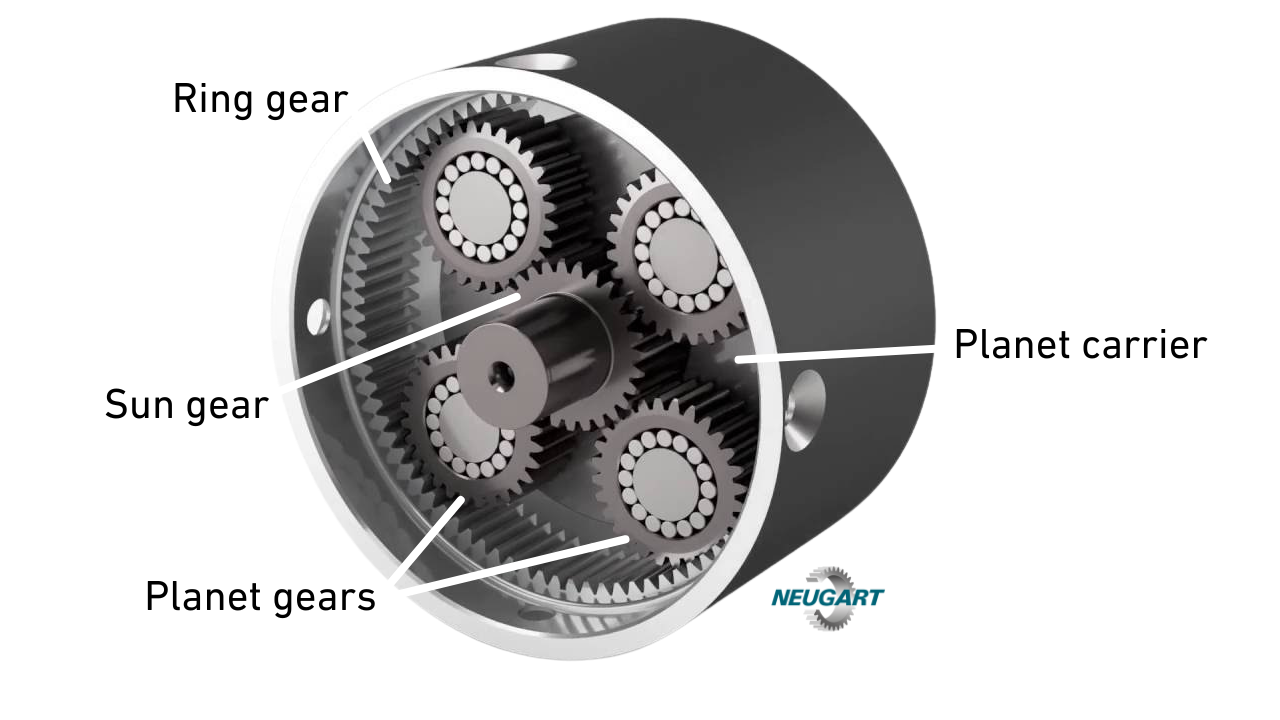
A planetary gearbox reducer is one of the most efficient and compact power transmission devices in modern mechanical engineering. Its fundamental architecture—comprising a sun gear, multiple planet gears, a ring gear, and a planet carrier—allows exceptional torque density within a coaxial layout. However, not all gear box reducer designs are created equal. The output torque requirement is the primary driver that dictates every structural decision, from gear module selection to bearing configuration and housing material. This article examines how planetary gearbox reducer architectures evolve across low, medium, and high-torque applications, with specific design examples and structural illustrations.
Low-Torque Range (5–50 N·m): Compact Single-Stage Precision
For applications requiring output torque below 50 N·m—such as small stepper motors, camera gimbals, medical devices, and laboratory automation—the structural priority is miniaturization, low backlash, and minimal weight. These planetary gearbox reducer units typically employ a single-stage configuration with a reduction ratio of 3:1 to 10:1.
The gear module is small (typically m = 0.3–0.8 mm), and the gears are often manufactured from powder metallurgy or high-performance engineering plastics like POM or PA66+GF30 to reduce noise and cost. The sun gear is directly integrated with the motor shaft or connected via a clamping hub. Planet gears usually ride on fixed pins with bronze or polymer bushings rather than full needle-roller bearings to save radial space. The ring gear is machined directly into the aluminum alloy housing (6061-T6 or 7075), which also serves as the outer structural shell. Output bearings are typically small deep-groove ball bearings or miniature angular-contact pairs.
Example: A 42 mm planetary gearbox reducer paired with a NEMA 17 stepper motor delivers an output torque of 8–25 N·m. The entire assembly weighs less than 300 g and achieves backlash below 15 arcminutes, making it ideal for 3D printers and compact pick-and-place robots.

Medium-Torque Range (50–500 N·m): Multi-Stage Alloy Steel Construction
When output torque demands increase to the medium range—common in industrial robotic joints, automated guided vehicles (AGVs), CNC machine tools, and packaging machinery—the gear box reducer must transition to a multi-stage (typically two-stage or three-stage) layout with ratios from 15:1 to 100:1. Structural integrity becomes the dominant design factor.
At this level, all gears are machined from alloy steels such as 20CrMnTi or 42CrMo, followed by carburizing, quenching, and precision grinding (ISO 1328 Class 6 or better). The gear module increases to m = 1.0–2.5 mm. The planet carrier evolves from a simple stamped plate into a one-piece CNC-machined steel or nodular iron (QT500-7) component with integral planet gear pins and needle-roller bearings to handle higher radial loads. The output shaft is supported by a duplex pair of tapered roller bearings or angular-contact ball bearings preloaded to eliminate axial play. The housing shifts from aluminum to high-strength cast iron (HT250) or thick-walled aluminum extrusions with ribbed reinforcement to prevent deformation under torsional stress.
Example: An 80 mm frame planetary gearbox reducer designed for a 750 W servo motor outputs 180 N·m continuously. It uses a two-stage arrangement with three planet gears per stage, a monolithic steel planet carrier, and an output flange conforming to ISO 9409-1 for direct robot-arm mounting. The housing incorporates an O-ring sealed labyrinth to protect bearings in dusty factory environments.
High-Torque Range (>500 N·m): Heavy-Duty Reinforced Architecture
For heavy industries—wind turbines, mining conveyors, marine propulsion, and large slewing drives—the planetary gearbox reducer must manage extreme torque exceeding 500 N·m, often reaching 5,000 N·m or more. The structural design departs dramatically from compact precision models.
These units employ three or more stages, sometimes with an additional spur-gear pre-stage or a bevel-gear input stage for motor-shaft offset. Gear modules are large (m ≥ 3.0 mm), with tooth profiles optimized for maximum bending strength and contact fatigue resistance. The ring gear is no longer an integral housing feature; instead, it is manufactured as a separate, hardened steel insert (58–62 HRC) shrink-fitted into a massive nodular cast iron or welded steel housing. Planet carriers become forged steel assemblies with cross-roller or cylindrical-roller bearings capable of withstanding extreme shock loads.
The output shaft transitions from a simple keyed shaft to a large-diameter flange output (per DIN 5480 or custom bolt patterns) or a hollow bore design for direct pinion or cable routing. Lubrication upgrades from simple grease packing to forced oil circulation with cooling circuits, filters, and temperature sensors. Torque sensors and multi-turn absolute encoders are frequently integrated into the output stage for closed-loop control.
Example: A high-torque hub-drive planetary gearbox reducer used in heavy-duty electric off-road vehicles integrates a frameless torque motor, a three-stage planetary train, and a precision output encoder. The unit delivers 2,800 N·m peak torque. The planet carrier is suspended on double-row tapered roller bearings inside a rigid inner housing, while the outer ring gear is bolted to the wheel hub. A dedicated oil pump circulates synthetic lubricant through external cooling channels to manage thermal loads during continuous hill-climbing operations.
Comparative Structural Summary
The transition across torque classes reveals a clear hierarchy of structural escalation:
| Feature | Low Torque (<50 N·m) | Medium Torque (50–500 N·m) | High Torque (>500 N·m) |
|---|---|---|---|
| Stages | Single | Two to three | Three or more |
| Gear Material | Powder metal / plastic | Alloy steel, carburized | Forged alloy, hardened |
| Module | 0.3–0.8 mm | 1.0–2.5 mm | ≥3.0 mm |
| Planet Carrier | Stamped / simple | CNC steel / nodular iron | Forged steel, welded |
| Bearings | Deep-groove / bushings | Tapered / angular contact | Cross-roller / cylindrical |
| Housing | Aluminum alloy | Cast iron / extruded Al | Nodular iron / welded steel |
| Output | Plain shaft / keyway | Flange / servo mount | Large flange / hollow shaft |
| Lubrication | Grease | Grease / oil bath | Forced oil + cooling |
Conclusion
The planetary gearbox reducer is a remarkably scalable technology. From a 30-gram micro-gearhead delivering 5 N·m to a 200-kilogram industrial drive transmitting 5,000 N·m, the underlying epicyclic principle remains constant, yet the structural realization changes fundamentally. Designers must match gear module, stage count, material grade, bearing class, and housing rigidity to the target torque. Selecting the correct gear box reducer architecture for the torque class ensures not only mechanical survival but also optimal efficiency, service life, and total cost of ownership. Whether your application demands precision positioning or brute-force material handling, understanding these torque-driven structural distinctions is essential to specifying the right planetary gearbox reducer for the job.


Leave A Comment