
Planetary Gear Reducer: The Power Behind Modern Logistics Automation
The global logistics industry is undergoing a profound transformation driven by e-commerce growth, labor shortages, and the relentless demand for faster delivery. At the center of this revolution are automated material handling systems—conveyors, robots, autonomous vehicles, and high-density storage systems—that move millions of packages with speed and precision. Powering virtually every motion in these systems is a compact yet mighty component: the planetary gear reducer. With its exceptional torque density, compact footprint, and reliable performance, the planetary gear reducer has become the mechanical backbone of logistics automation. This article explores the specific application scenarios where planetary gear reducers drive efficiency in modern distribution centers and warehouses.
Automated Guided Vehicles (AGVs) and Autonomous Mobile Robots (AMRs)
Drive Wheel Systems
AGVs and AMRs navigate warehouse floors autonomously, transporting pallets, totes, and individual parcels across vast facilities. Each drive wheel assembly integrates a planetary gear reducer with a servo motor to deliver the precise speed-torque characteristics required for smooth acceleration, steady cruising, and accurate positioning.
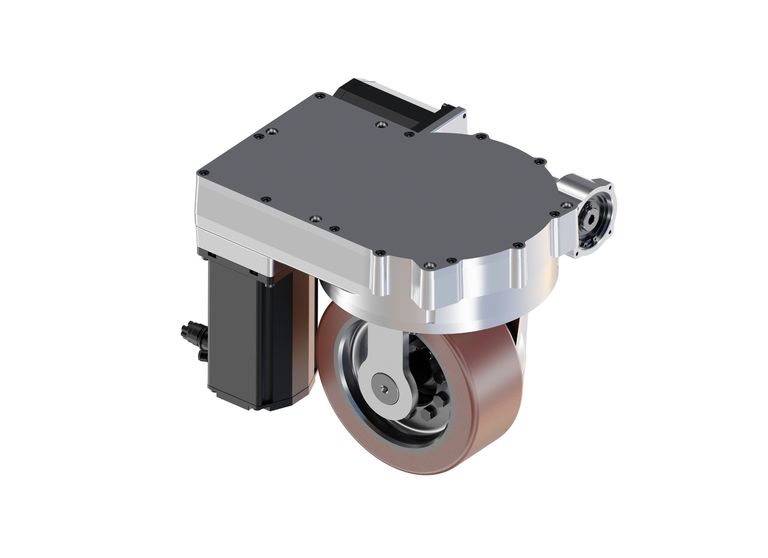
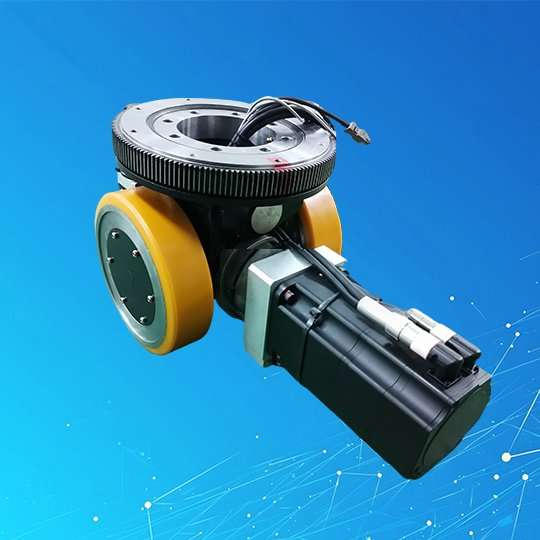
The planetary gear reducer in AGV applications must overcome several unique challenges. First, the gearbox must fit within the tight confines of a drive wheel hub while delivering sufficient torque to move loads weighing hundreds of kilograms. Second, it must operate quietly to meet workplace noise standards. Third, it must provide precise velocity control for dead-reckoning navigation accuracy. Planetary gear reducers excel in all three areas: their coaxial design keeps the motor and gearbox aligned along the wheel axis, their multi-stage gear meshing distributes load for quiet operation, and their low backlash (often below 3 arcminutes) ensures that encoder feedback translates directly into predictable wheel rotation. For omnidirectional AGVs, compact planetary reducers enable swerve-drive modules that combine steering and propulsion in a single, space-saving unit.
Automated Storage and Retrieval Systems (AS/RS)
Stacker Crane Hoist and Traverse Drives
In high-bay warehouses where vertical space is maximized, AS/RS stacker cranes retrieve and store pallets at heights exceeding 40 meters. These cranes demand precise, high-speed motion along three axes: horizontal traverse, vertical lift, and fork extension. A planetary gear reducer drives each of these motions.

The hoist drive faces the most demanding conditions. It must lift and lower heavy pallets with absolute precision to align with rack openings just millimeters wider than the pallet itself. Planetary gear reducers provide the high reduction ratios (often 30:1 to 100:1) necessary to convert high-speed motor rotation into slow, powerful lifting motion. Their inherent load-sharing across multiple planet gears ensures smooth operation without the jerky motion that could destabilize tall loads. For traverse drives, planetary reducers deliver rapid horizontal acceleration while maintaining position accuracy within ±1 mm—critical for avoiding collisions in narrow rack aisles. The compact design of planetary gearboxes allows them to fit within the crane’s mast structure, maximizing payload capacity and minimizing overall crane weight.
Conveyor and Sorting Systems
Belt and Roller Conveyor Drives
Conveyor systems form the circulatory system of every modern distribution center, moving packages from receiving docks through sorting, packing, and shipping zones. Planetary gear reducers power the drive rollers and belt pulleys that keep these systems flowing 24/7.
In high-throughput facilities handling tens of thousands of parcels per hour, conveyor sections must start and stop rapidly to create gaps between packages for barcode scanning and diverter routing. Planetary gear reducers provide the high starting torque needed to accelerate loaded belts instantly while their excellent efficiency (97% per stage) minimizes heat buildup during continuous operation. For heavy-duty pallet conveyors, planetary reducers handle loads exceeding 1,500 kg per meter, with overload capacities of 200–300% rated torque to accommodate sudden impacts when pallets are dropped onto the line. The distributed load among planet gears ensures even wear, extending maintenance intervals in facilities where downtime costs thousands of dollars per minute.
Automated Parcel and Packet Sorters
Modern parcel sorters use a variety of mechanisms—tilt trays, cross-belt carriages, pop-up wheels, and sliding shoe diverters—to route packages to the correct outbound chute. Each diverter mechanism relies on a planetary gear reducer to execute rapid, precise actuation.
In tilt-tray sorters, for example, planetary reducers rotate each tray through exactly 35–45 degrees within 200 milliseconds to discharge a parcel into the target chute. The low backlash of precision planetary gearboxes ensures that every tray returns to a perfectly level position, preventing packages from sliding prematurely. Cross-belt sorter carriages use planetary reducers to drive the small belts that transfer parcels laterally off the main loop. Here, the reducer’s compact size is essential—the entire drive must fit within a carriage just a few centimeters tall, traveling at speeds up to 3 meters per second.
Robotic Palletizing and Depalletizing
Articulated Robot Joint Drives
At the end of production and packing lines, articulated robots stack cartons onto pallets with tireless consistency. Each joint—base rotation, shoulder, elbow, and wrist—incorporates a planetary gear reducer to amplify servo motor torque while maintaining precise angular control.
Palletizing robots handle payloads from 50 kg to over 800 kg, requiring joint torques that would overwhelm direct-drive motors. Planetary gear reducers with reduction ratios from 50:1 to 160:1 deliver the necessary torque multiplication within a compact envelope that fits inside the robot’s cast joint housings. The coaxial input-output alignment allows motors to be mounted directly along the joint axis, creating a clean, robust mechanical package. Low backlash ensures that the end-effector reaches its programmed pick and place coordinates with sub-millimeter repeatability, even when handling offset or partially collapsed cartons. For collaborative palletizing applications, planetary reducers with integrated torque sensors enable force-limiting functionality, allowing robots to work safely alongside human operators.
The Technical Advantage
What makes the planetary gear reducer uniquely suited to logistics automation? Its fundamental architecture—a central sun gear, multiple planet gears meshing with an internal ring gear, and a planet carrier output—delivers decisive benefits:
- High Torque Density: Multiple planet gears share the load, enabling higher torque per unit volume than parallel-shaft or worm gear alternatives.
- Compact Coaxial Design: Input and output shafts align on the same axis, saving critical space in AGV wheel hubs, robot joints, and sorter carriages.
- Smooth, Quiet Operation: Even load distribution minimizes vibration and noise—essential for facilities operating near office spaces.
- Exceptional Efficiency: Per-stage efficiency reaches 97%, reducing energy consumption and heat generation in continuous-duty applications.
- Backlash Control: Precision-ground variants achieve backlash below 1 arcminute, enabling the accurate positioning required by AS/RS cranes and sorting diverters.
From the drive wheels of autonomous robots navigating warehouse aisles to the towering stacker cranes accessing pallets forty meters in the air, the planetary gear reducer serves as the silent enabler of logistics automation. Its unmatched combination of torque density, precision, compactness, and reliability addresses the core mechanical challenges faced by conveyor systems, sorting machines, mobile robots, and industrial manipulators. As the logistics industry continues its relentless pursuit of speed, accuracy, and cost efficiency, the planetary gear reducer will remain a foundational technology—converting electrical power into the controlled mechanical motion that moves the world’s goods.


