

A planetary gearbox is one of the most versatile and efficient power transmission devices in modern engineering. Unlike traditional gear systems, a planetary gearbox uses a central sun gear, multiple planet gears, and an outer ring gear to distribute torque across multiple contact points. This unique configuration delivers exceptional torque density, compact size, and remarkable efficiency—making the planetary gearbox the preferred gearbox reducer across countless industries.
1. Industrial Robotics and Automation
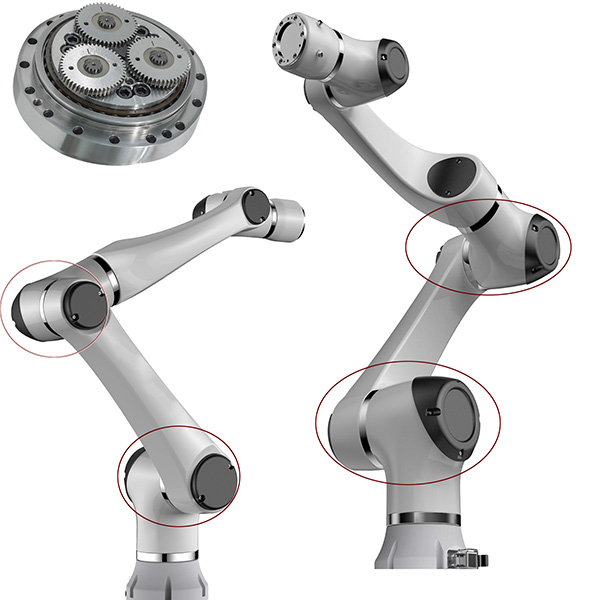
The robotics industry heavily relies on planetary gearbox technology. Collaborative robots (cobots) and industrial robotic arms require gearbox reducer units that provide high torque output in minimal space while maintaining precise positioning accuracy.
In robotic joints, a planetary gearbox typically achieves reduction ratios from 10:1 to 100:1, enabling servo motors to deliver the high torque needed for lifting, welding, and assembly operations. The backlash of a precision planetary gearbox can be controlled below 3 arc-minutes, ensuring repeatable positioning accuracy essential for automated manufacturing lines.
Real-world example: Universal Robots and KUKA robotic arms utilize compact planetary gearbox units at each joint, allowing 6-axis movement with payloads up to 300kg while maintaining smooth, vibration-free motion.

2. Solar Tracking Systems
Solar energy harvesting demands precise angular positioning throughout the day. A planetary gearbox integrated into slewing drives enables single-axis and dual-axis solar tracker systems to follow the sun’s path with accuracy within ±0.5 degrees.
The gearbox reducer in solar applications must withstand outdoor environments, temperature extremes, and continuous operation for 25+ years. Planetary slewing drives combine the planetary gearbox with a worm gear stage, achieving high reduction ratios (up to 3,000:1) while providing self-locking characteristics that prevent back-driving during wind gusts.
Real-world example: Large-scale solar farms in Spain and the United States deploy thousands of planetary gearbox-driven tracking systems, increasing energy yield by 25-35% compared to fixed installations. Companies like NEXTracker and Array Technologies rely on robust gearbox reducer technology for their tracking solutions.
3. Wind Turbine Power Transmission
Modern wind turbines represent one of the most demanding applications for planetary gearbox systems. A typical 3MW wind turbine requires a main gearbox reducer to increase the rotor’s slow rotation (10-20 RPM) to the generator’s operating speed (1,000-1,800 RPM).
The planetary gearbox in wind turbines handles enormous torque loads—often exceeding 3,000 kNm—while operating in harsh offshore and onshore environments. Multi-stage planetary gearbox designs with 2-3 planetary stages achieve the necessary speed increase while distributing loads across multiple gear meshes, extending service life beyond 20 years.
Real-world example: Vestas and Siemens Gamesa turbines employ advanced planetary gearbox technology in their drivetrains, with some offshore units featuring gearbox reducer systems rated for 8MW+ capacity, transmitting power from 80-meter diameter rotors.
4. Material Handling and Conveyor Systems
Warehouses and distribution centers depend on planetary gearbox drives for conveyor belts, palletizers, and automated guided vehicles (AGVs). These applications require a gearbox reducer that delivers consistent torque, operates quietly, and fits within compact machinery footprints.
The high efficiency (typically 97-98% per stage) of a planetary gearbox minimizes energy consumption in facilities running 24/7 operations. Additionally, the coaxial input-output shaft arrangement of a planetary gearbox simplifies mechanical integration into conveyor frames.
Real-world example: Amazon fulfillment centers utilize thousands of planetary gearbox-driven conveyor modules, each handling packages up to 50kg while maintaining speeds of 2-3 meters per second. AGVs equipped with wheel-mounted gearbox reducer units navigate warehouse floors with precision.
5. Construction and Mining Equipment
Heavy machinery such as excavators, cranes, and tunnel boring machines rely on planetary gearbox systems for swing drives, winch mechanisms, and track drives. These gearbox reducer applications demand extreme durability, shock-load resistance, and high torque multiplication.
In excavator swing drives, a planetary gearbox typically provides reduction ratios of 20:1 to 40:1, enabling smooth 360-degree rotation of the upper structure while supporting loads exceeding 50 tons. The multiple planet gear arrangement distributes these massive forces, preventing premature wear.
Real-world example: Caterpillar and Komatsu excavators use custom planetary gearbox swing drives rated for continuous duty cycles in mining operations. Tower cranes employ gearbox reducer hoisting mechanisms with dual-stage planetary gearbox configurations to lift loads up to 20 tons to heights exceeding 300 meters.
Conclusion
From precision robotics to massive wind turbines, the planetary gearbox has proven indispensable across virtually every sector of modern industry. Its unique ability to combine high torque density, compact dimensions, and exceptional efficiency makes the planetary gearbox the ultimate gearbox reducer solution for engineers worldwide.
Whether you are designing a solar tracking system, automating a production line, or developing next-generation renewable energy equipment, selecting the right planetary gearbox ensures optimal performance, reliability, and long-term value. As industries continue demanding higher power density and greater precision, the planetary gearbox will remain at the heart of mechanical power transmission innovation.


Leave A Comment